

New Construction Homes Near Me: A Complete, Proven Roofing Quality Checklist
Searching for new construction homes near me usually means you are comparing floor plans, neighborhoods, finishes, and builder incentives. But the roof deserves just as much attention because a new roof can still be installed poorly.
Fresh shingles can hide bad fastening, missing flashing, blocked ventilation, weak drainage, or shortcuts in the attic. Those problems may not show up during a walkthrough, but they can show up later as leaks, lifted shingles, stained ceilings, and warranty fights.
Use this checklist before you close on a new construction home in Mississippi. You can check some items from the ground or attic, and you can ask the builder, inspector, or roofing contractor to verify the details you cannot safely inspect yourself.
Why a New Roof Is Not Automatically a Good Roof
Speed is not the enemy. Rushing the parts you cannot see after the drywall goes up is. Once the decking is covered, the underlayment is hidden, and the soffit is wrapped, the only way to verify quality is to know what questions to ask and what evidence to look for.
New construction also moves through several different crews. The framers set the trusses, a separate crew dries it in, and a shingle crew finishes it, sometimes on a tight quota where they are paid by the square rather than by the quality of the detail work. Each handoff is a chance for a small mistake to get buried under the next layer. That is not a reason to fear new construction. It is a reason to inspect it like the major purchase it is.
A roof failure on a five-year-old home is rarely about the shingles wearing out. It is almost always about how the roof was put together on day one: the fasteners, the flashing, and the airflow. Those are the things this checklist targets.
Check Out These Roofing Quality Checklist When Looking for New Construction Homes Near Me
Work through these seven points on any home you are seriously considering. You can do the visual parts yourself from the ground and the attic, and the rest you can confirm with the builder or an independent inspector.
Decking and Sheathing
From the attic, the underside of the roof deck should look uniform with no daylight showing through the seams and no obvious sagging between rafters. Panels should be properly spaced and fastened, not buckled. Wavy or springy decking underfoot signals thin sheathing or wide framing spacing that will telegraph through the shingles within a few years.
Underlayment and Ice or Water Protection
Ask what went down before the shingles. Synthetic underlayment over the full deck plus a self-adhered membrane in the valleys and along the eaves is the standard you want. This layer is hidden once the shingles are on, so the time to confirm it is before closing, ideally with photos the builder took during the dry-in stage.
Flashing at Every Penetration
Walk the perimeter and look up at every chimney, vent pipe, skylight, and wall-to-roof joint. You want to see real metal step flashing and counter-flashing, not a smear of caulk or roofing tar doing the job. Sealant is a finishing touch, never the waterproofing itself. Tar-only “flashing” is the single most common shortcut we find on fast builds.
Shingle Installation and Nailing
Lines should be straight and the courses even. Look closely at the field for nails that sit proud of the shingle or are driven at an angle, and for any nail heads showing above the shingle line. Overdriven or underdriven nails void most manufacturer warranties and are a leading cause of shingles blowing off in high wind.

Attic Ventilation
A balanced system pulls cool air in at the soffit and pushes hot air out at the ridge. In the attic, confirm the soffit vents are actually open and not painted shut or buried under insulation, and that there is a continuous ridge vent or enough exhaust vents. Poor airflow cooks shingles from below and traps moisture, the two fastest ways to shorten a roof’s life in a humid climate.
Structure and Bracing
Trusses should sit plumb and evenly spaced, tied together with diagonal and lateral bracing, not left as a row of unbraced verticals. Look for the manufacturer’s stamp on the trusses, which proves they were engineered and graded rather than field-built. Never accept a roof where trusses have been cut or modified on site without an engineer’s sign-off.
Gutters, Drip Edge, and Drainage
A metal drip edge should run along every eave and rake, positioned correctly relative to the underlayment so water sheds into the gutter instead of behind the fascia. Confirm the gutters are pitched to the downspouts and that the grading carries water away from the foundation. Drip edge is cheap and often skipped, and its absence rots fascia and soffit fast.
Structural Details That Separate a Short-Lived Roof From a Long-Lasting Roof
Most of a roof’s lifespan is decided by the parts you will never see again after the home is finished, so it is worth understanding what good looks like underneath the surface.
Fastening, Not Just Nailing
The way framing members connect matters as much as the lumber itself. Engineered metal connector plates and hangers create a far stronger joint than old-fashioned angled, or “toe,” nailing, which can split the wood and leave a weak connection. On the trusses, the multi-nail plates pressed into each joint at the factory are what let the truss carry the load of decking, shingles, wind, and the occasional Mississippi ice without sagging.
Wind Bracing You Can Actually See
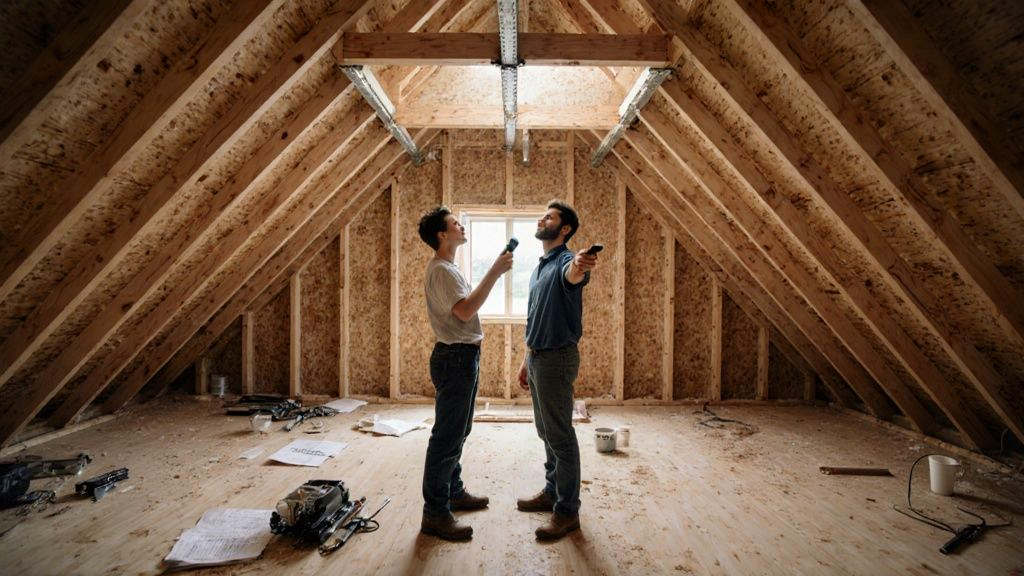
A roof is essentially a long row of vertical members, and wind hitting a gable end can topple them like dominoes if they are not triangulated. Proper diagonal bracing run from the wall plate up toward the ridge stiffens the whole structure against uplift and racking. In the attic, bracing that runs at an angle across the rafters, rather than only straight runs, is a sign the framer understood this.
The Wall Plate and Birdsmouth
Where the rafters meet the top of the wall, they should sit on a level, solidly anchored wall plate and be notched with a clean birdsmouth cut that still leaves most of the rafter depth intact for strength. An over-cut notch weakens both the overhang and the connection. These are small details, but they are the difference between a roof that holds its shape for decades and one that slowly spreads.
“From start to finish, the team was professional, knowledgeable, and incredibly thorough. They took the time to explain every part of the inspection process and made dealing with insurance simple and stress-free.”
Joshua R., verified Google reviewVentilation and Flashing: The Two Most-Skipped Details
If you only have time to scrutinize two things, make them ventilation and flashing. They cause the majority of the premature roof failures we are called out to fix on homes that are barely out of their builder warranty.
Flashing fails because it was never installed correctly in the first place, replaced by sealant that dries, cracks, and lets water creep in at the worst possible angle. Ventilation fails quietly: a hot, humid attic bakes the asphalt out of the shingles and grows the kind of moisture problems that ruin decking and insulation long before anyone spots a leak. Both are invisible on a quick showing, and both are expensive to correct after move-in. Getting them right is also central to any quality professional roof installation done by expert residential roofers.

Questions to Ask the Builder Before You Close
A good builder should be able to answer roof questions clearly. If the answers are vague, defensive, or buried under sales talk, pay attention. That does not automatically mean the roof is bad, but it does mean you need documentation.
Ask these questions before closing:
- What shingle brand and product line was installed?
- What underlayment was used?
- Was self-adhered leak barrier installed in valleys, eaves, or roof-to-wall transitions?
- Are dry-in photos available?
- Who installed the roof: an in-house crew or subcontractor?
- Is the roofing contractor licensed and insured?
- What workmanship warranty applies?
- What manufacturer warranty applies?
- Is the warranty transferable?
- Who handles a leak during the first year?
- Were truss design drawings provided?
- Were any roof trusses cut, drilled, modified, or repaired?
- Has the attic ventilation been calculated, not just visually guessed?
Compare answers across builders if you are touring several new construction homes near me. The careful builders usually sound specific. The rushed ones usually sound vague.
Get an Independent Roof Inspection Before You Sign
A general home inspection is valuable, but most home inspectors are generalists who glance at the roof rather than evaluate it as a system. For a purchase this size, a dedicated roof inspection from a licensed roofer is cheap insurance. We climb the roof, check the attic, and document the fasteners, flashing, ventilation, and structure with photos, so you walk into closing knowing exactly what you are buying.
That same scrutiny is why so many local homeowners choose us when the roof finally does need attention, whether that is a future residential roof replacement or simply planning ahead. If you want to dig deeper into how roofs are evaluated, the National Roofing Contractors Association publishes homeowner guidance worth a read.
Buying new construction should feel exciting, not nerve-racking. Run the checklist, ask the questions, and bring in a second set of expert eyes. A little diligence now is what keeps that perfect-looking new roof actually performing for the next thirty years.