

Proven Roofing Leakage Repair: Complete Step-by-Step Guide
Southern Mississippi’s intense humidity, heavy rain, and hurricane winds can quickly turn a minor drip into a structural disaster. From ceiling damage to mold risks and rotted decking, the consequences of a leaky roof are severe. Timely roofing leakage repair is the only way to prevent attic moisture from destroying your insulation and driving up energy costs.
This guide walks you through identifying leak sources, stopping active water damage, and understanding permanent fix options. Our team at TopCo Roofing is here to provide the expert craftsmanship needed to protect your biggest investment.
Common Causes of Roof Leaks in Mississippi Homes
Understanding why your roof is leaking is the first step toward a successful repair. In our region, the combination of extreme heat and heavy precipitation creates unique points of failure that homeowners should be aware of.
Here are the common causes of roofs to look out for in Mississippi homes:
Failed Flashing Around Chimneys, Walls, and Skylights
Flashing protects roof transitions like chimneys by directing water away from vertical surfaces using thin metal strips. Mississippi’s intense sun and coastal storms often crack sealants or loosen these strips, creating gaps for wind-driven rain to enter. Since these areas are highly vulnerable to weather damage, failed flashing is a frequent cause for professional roofing leakage repair.
Missing, Cracked, or Lifted Shingles
Shingles are your home’s primary line of defense, but they are not invincible. Southern Mississippi is frequently hit by hail and high-velocity winds that can strip the granules right off your asphalt shingles. Once those granules are gone, the underlying bitumen is exposed to UV rays, causing the shingle to become brittle and crack.
Strong winds often break shingle sealant strips, causing them to flap without blowing off the roof entirely. These unsealed shingles allow water to seep underneath during storms, causing hidden damage to the underlying structure. Spotting these subtle failures is a critical step in roofing leakage repair because they often look perfectly fine from the ground.
Cracked Pipe Boots and Roof Vent Leaks
Plumbing vents are sealed with rubber boots that often become brittle and crack under Mississippi’s intense heat cycles. These cracks allow water to flow down the pipe and into your attic, causing significant interior damage. Addressing failed boots and clogged vents is a vital part of a professional repair to prevent ongoing moisture intrusion.
Valleys, Gutters, and Poor Drainage
Roof valleys are the areas where two roof slopes meet. Because they handle a massive volume of water during a heavy downpour, they are prone to leaks if the underlayment is compromised or if debris like pine needles and leaves builds up.
When gutters are clogged, water backs up under the eaves, a phenomenon known as “wicking.” This can rot your fascia boards and allow water to enter the soffit, leading to expensive repairs that go far beyond a simple repair.
Roofing Leakage Repair: Step-by-Step Process

When you realize water is entering your home, your response time is critical. We follow a specific, proven methodology to ensure that every roofing leakage repair we perform is thorough and long-lasting. Here is how you should handle the situation.
Protect the Interior and Stop Active Water Damage
Protect your home by moving valuables and using buckets to catch active drips as soon as a leak is spotted. Prevent a sudden ceiling collapse by carefully poking a small hole in any drywall “bubbles” to drain the trapped water. Always avoid touching nearby electrical fixtures to ensure your safety when arranging a professional roofing leak repair.
Document the Leak and Visible Damage
Before you or a professional starts the repair, you need a clear record of the incident. Take high-quality photos and videos of everything: the active drip, the stains on the ceiling, the damp insulation in the attic, and any damage to your personal property. Documentation is essential if you plan to file an insurance claim, especially after a major weather event such as a hurricane or severe thunderstorm.
Locate the Likely Source of the Leak
Locating the precise entry point is often difficult because water can travel along rafters far from the initial hole before reaching your ceiling. If it is safe to do so, use a flashlight in your attic during a storm to spot wet nails or moisture trails. Trace these signs back to common transition points like chimneys and valleys to identify the source of the intrusion.
Apply a Temporary Dry-In if Safe
If the weather permits and the roof is safely accessible, a temporary “dry-in” can prevent further damage until a permanent roofing leakage repair is completed. This usually involves securing a heavy-duty tarp over the affected area. The tarp should extend over the roof ridge to prevent water from running along the top edge. It is important to understand that a tarp is not a fix; it is a temporary bandage designed to buy you time.
Complete the Permanent Roof Repair
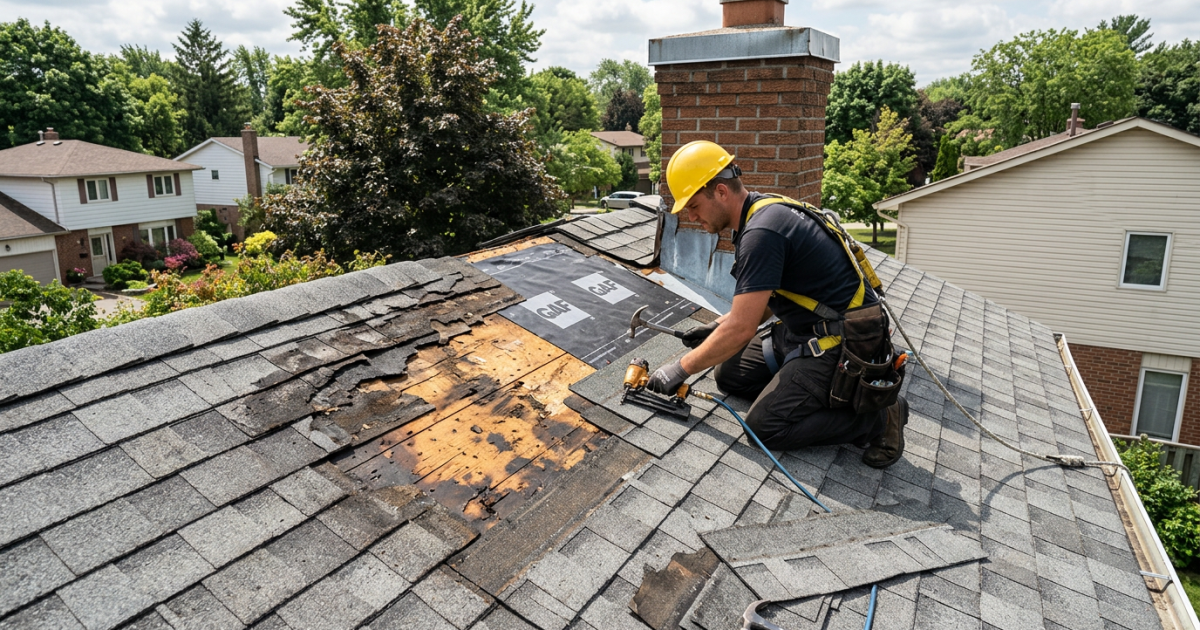
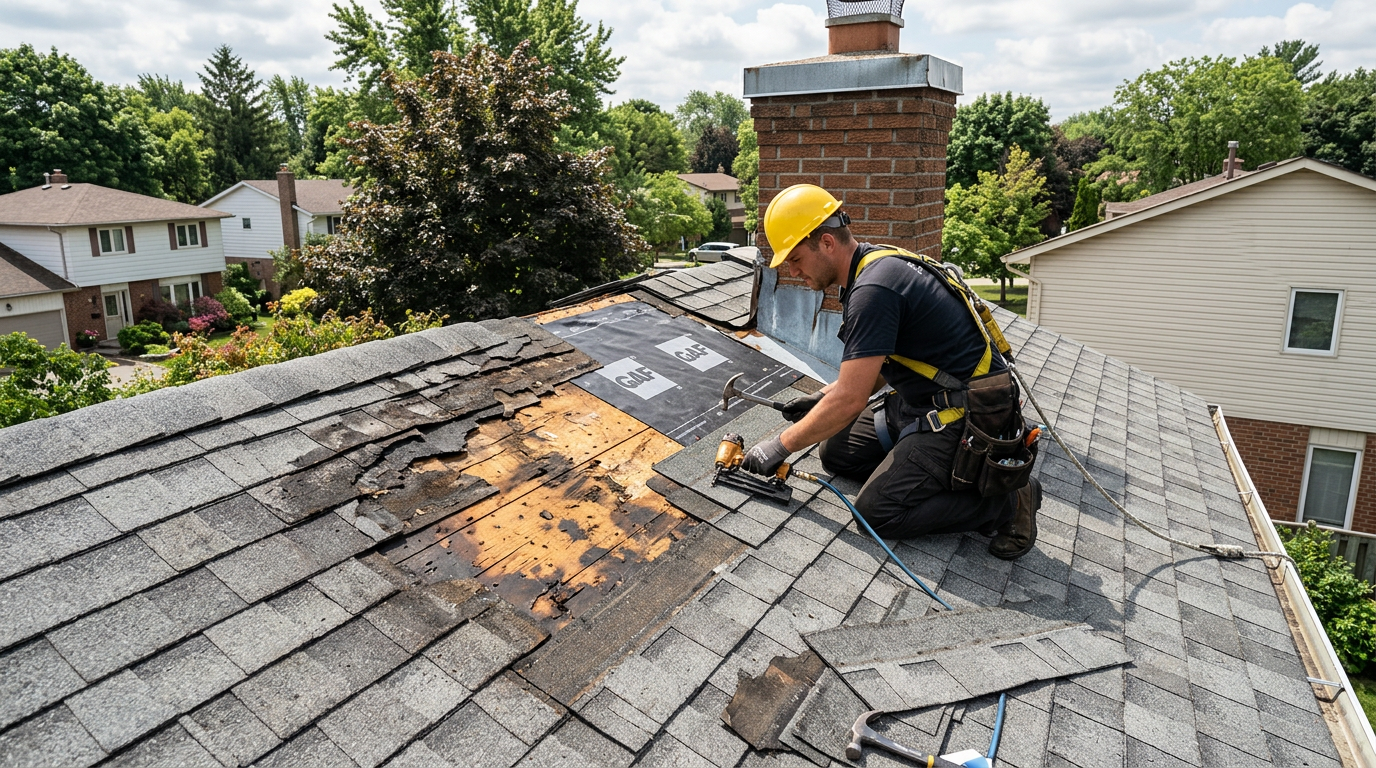
A permanent roofing leakage repair involves more than just a tube of caulk. Our team will remove the damaged shingles and underlayment to inspect the wood decking underneath. If the decking is soft or rotten, it must be replaced to ensure a solid nailing surface. We then install high-quality ice and water shields, new flashing, and color-matched shingles. We ensure that all fasteners are driven correctly and that the roof’s integrated water-shedding system is fully restored to its original integrity.
Temporary Fixes vs Permanent Roof Leak Repairs
It is easy to get lulled into a false sense of security once the dripping stops, but homeowners must distinguish between a quick fix and a lasting solution.
What Counts as a Temporary Roof Leak Fix
A temporary fix is any measure taken to stop the flow of water in an emergency. This includes:
- Plastic sheeting or tarps weighted down with sandbags or nailed with furring strips.
- Emergency roofing cement, often called “mastic” or “bull,” applied to a visible hole.
- Caulk or sealant applied to a cracked pipe boot.
- Buckets and fans used to manage moisture inside the home.
These steps are vital during storm damage events when immediate professional help might be hours or days away.
Why Temporary Fixes Should Not Be Left in Place
Many homeowners make the mistake of leaving a tarp or a patch of roofing cement in place for months. This is dangerous for several reasons. Temporary materials are not designed to withstand the UV exposure and thermal cycles of Mississippi. They can trap moisture against the roof deck, accelerating rot and mold growth.
On top of that, a patch might stop the leak in one spot while redirecting water to another, more hidden area of the structure.
What Makes a Roof Leak Repair Permanent
A permanent roofing leakage repair addresses the root cause. It involves removing the “failed” components and replacing them with new materials that are properly integrated into the roof system. This means correctly overlapping shingles, using the right weight of underlayment, and ensuring that all flashing is counter-flashed and sealed.
The National Roofing Contractors Association (NRCA) emphasizes proper roof system design and installation practices. In that same spirit, a lasting roof repair should restore the roof’s water-shedding function by correcting the failed component, rather than relying on temporary sealants as the long-term solution.
DIY Roofing Leakage Repair vs Calling a Professional
While the “Do-It-Yourself” spirit is strong in Mississippi, the roof is one place where mistakes can be incredibly costly and physically dangerous.
When a Minor DIY Repair May Be Possible
Consider a DIY approach for very minor, easily accessible issues. For example, if a single shingle was blown off a low-slope roof and you have the exact replacement shingle and the proper roofing nails, a capable homeowner could handle it. However, this should only be attempted when the roof is completely dry, you have the proper safety gear, and the roof’s pitch is shallow enough to walk on safely.
When To Call for Professional Roof Repair Services
Most roofing leakage repair scenarios require professional roof repair services. You should always call us if:
- The roof is steep or more than one story high.
- The leak is near electrical lines, solar panels, or satellite dishes.
- The roof deck feels soft or “spongy” when you walk on it.
- You have multiple leaks or recurring issues in the same spot.
- The damage involves complex flashing around chimneys or skylights.
Business owners facing similar issues should look for specialized commercial leak repair contractors who understand the complexities of flat or low-slope commercial systems. These structures often require different materials and techniques than those used for residential homes to ensure a watertight seal.